This event will bring together authors of two recent books about urban data, intelligence, activism and the public good: Sarah Williams’ Data Action: Using Data for Public Good and Shannon Mattern’s A City Is Not a Computer: Other Urban Intelligences. In Data Action, Sarah Williams provides a guide for working with data in more ethical and responsible ways. Big data can be used for good--from tracking disease to exposing human rights violations – and for bad – implementing surveillance and control. Data inevitably represents the ideologies of those who control its use; data analytics and algorithms too often exclude women, the poor, and ethnic groups. Too often data has been used – and manipulated – to make policy decisions without much stakeholder input. Williams outlines a method that emphasizes collaboration among data scientists, policy experts, data designers, and the public. This approach creates trust and co-ownership in the data by opening the process to those who know the issues best. Computational models of urbanism — smart cities that use data-driven planning and algorithmic administration — promise to deliver new urban efficiencies and conveniences. Yet these models limit our understanding of what we can know about a city. Shannon Mattern’s A City Is Not a Computer reveals how cities encompass myriad forms of local and indigenous intelligences and knowledge institutions, arguing that these resources are a vital supplement and corrective to increasingly prevalent algorithmic models. She looks at the methods and underlying assumptions of data-driven urbanism, and demonstrates how the “city-as-computer” metaphor, which undergirds much of today’s urban policy and design, reduces place-based knowledge to information processing. Mattern then imagines how we might sustain institutions and infrastructures that constitute more diverse, open, inclusive urban forms.
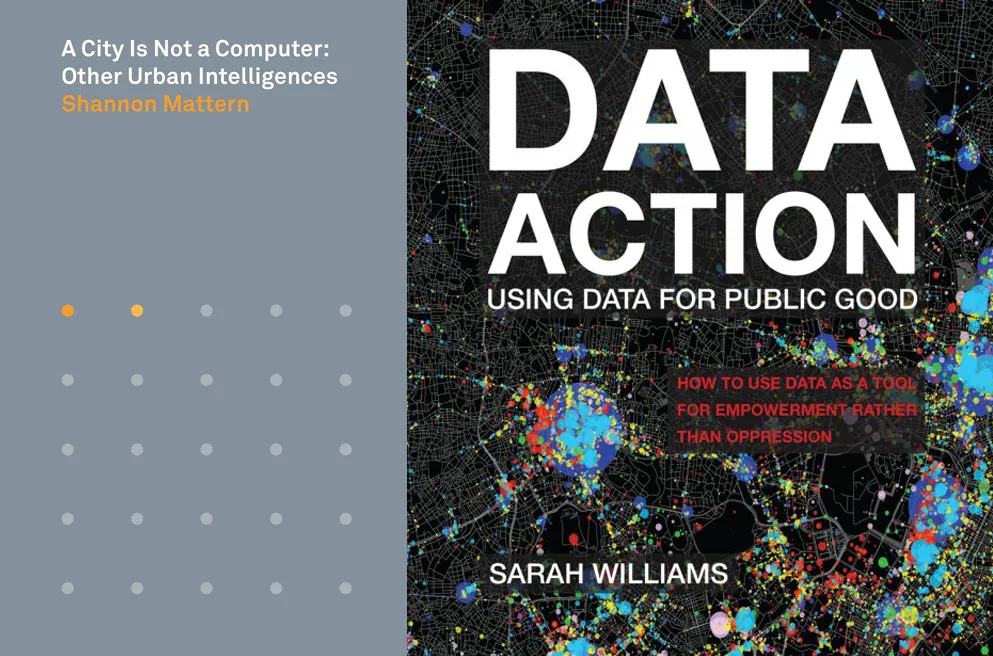
This event will bring together authors of two recent books about urban data, intelligence, activism and the public good: Sarah Williams’ Data Action: Using Data for Public Good and Shannon Mattern’s A City Is Not a Computer: Other Urban Intelligences.
In Data Action, Sarah Williams provides a guide for working with data in more ethical and responsible ways. Big data can be used for good—from tracking disease to exposing human rights violations—and for bad—implementing surveillance and control. Data inevitably represents the ideologies of those who control its use; data analytics and algorithms too often exclude women, the poor, and ethnic groups. Too often data has been used and manipulated to make policy decisions without much stakeholder input. Williams outlines a method that emphasizes collaboration among data scientists, policy experts, data designers, and the public. This approach creates trust and co-ownership in the data by opening the process to those who know the issues best.
Computational models of urbanism—smart cities that use data-driven planning and algorithmic administration—promise to deliver new urban efficiencies and conveniences. Yet these models limit our understanding of what we can know about a city. Shannon Mattern’s A City Is Not a Computer reveals how cities encompass myriad forms of local and indigenous intelligences and knowledge institutions, arguing that these resources are a vital supplement and corrective to increasingly prevalent algorithmic models. She looks at the methods and underlying assumptions of data-driven urbanism, and demonstrates how the “city-as-computer” metaphor, which undergirds much of today’s urban policy and design, reduces place-based knowledge to information processing. Mattern then imagines how we might sustain institutions and infrastructures that constitute more diverse, open, inclusive urban forms.